From meteorite strikes on Mars to the James Webb Space Telescope capturing multiple galaxies merging near a black hole, read about it all in our weekly space news recap.
The word “space” may conjure up images of planets, stars and other heavenly bodies that are light-years away from us, but that is because we forget that “space” is just 100 kilometres above us at any given time. And things that happen in space can sometimes have a profound impact on life on Earth.
For example, NASA instrument in space was able to detect many methane “super-emitters”
Methane is a potent greenhouse gas but compared to carbon dioxide, which lingers in the atmosphere for decades, methane lasts only decades in the atmosphere. This means that reducing methane emissions could produce more immediate impacts on climate change. Read about all that and more in our weekly space news recap.
NASA’S EMIT detects methane super emitters
NASA’s Earth Surface Mineral Dust Investigation, or EMIT, was mainly designed to study airborne dust and its effect on climate change but it has proven useful to detect a cause of climate change–detecting large “super-emitters” of methane from around the world.
According to Reuters, the device has identified more than 50 methane super-emitters in Central Asia, the Middle East and the Southwestern United States since it was installed on the International Space Station in July this year. Some of the methane hotspots discovered by the instrument were previously known while others were discovered for the first time. Examples of the super-emitters include oil and gas facilities and large landfills.
ISS swerves to avoid Russian debris
On November 21 last year,Russia conducted a “satellite defence test” where it shot down its own Cosmos 1408 satellite in a move that was widely condemned by space agencies around the world. Earlier this week, NASA announced that the International Space Station (ISS) had to fire its thrusters for 5 minutes and 5 seconds to dodge the debris from the satellite.
“This evening, the International Space Station’s Progress 81 thrusters fired for 5 minutes, 5 seconds in a Pre-Determined Debris Avoidance Maneuver (PDAM) to provide the complex an extra measure of distance away from the predicted track of a fragment of Russian Cosmos 1408 debris,” said a statement from the American space agency.
Such anti-satellite tests are nothing new. The United States was the first country to conduct such a test in 1959 when satellites were fairly new technology and much rarer. Even India conducted an anti-satellite test in 2019 when it used a surface-to-air missile to bring down its own satellite.
Bacteria under Martian surface
Researchers simulated the harsh ionising radiation on Mars in a new study where they found that ancient bacteria could potentially survive close to the surface of the planet much longer than previously thought. This means that scientists might even find bacteria and bacteria remains when the first samples from Mars come back to our planet.
The Indian Ex
HomeTechnologyScienceSpace news weekly recap: NASA’s UFO team, Marian bacteria and more
Space news weekly recap: NASA’s UFO team, Marian bacteria and more
From meteorite strikes on Mars to the James Webb Space Telescope capturing multiple galaxies merging near a black hole, read about it all in our weekly space news recap.
ADVERTISEMENT
By: Science Desk
Updated: October 30, 2022 4:15:05 pm
0
Imaging of a methane plume at least 3 miles (4.8 km) longImaging of a methane plume at least 3 miles (4.8 km) long rising from a major landfill, where methane is a byproduct of decomposition, south of Tehran, Iran, captured by NASA’s orbital imaging spectrometer, is overlaid on a satellite photo in this handout image released October 25, 2022. Google Earth/Maxar/NASA/JPL-Caltech/Handout via REUTERS
The word “space” may conjure up images of planets, stars and other heavenly bodies that are light-years away from us, but that is because we forget that “space” is just 100 kilometres above us at any given time. And things that happen in space can sometimes have a profound impact on life on Earth.
For example, a NASA instrument in space was able to detect many methane “super-emitters” on our planet. Methane is a potent greenhouse gas but compared to carbon dioxide, which lingers in the atmosphere for decades, methane lasts only decades in the atmosphere. This means that reducing methane emissions could produce more immediate impacts on climate change. Read about all that and more in our weekly space news recap.
ADVERTISEMENT
NASA’S EMIT detects methane super emitters
NASA’s Earth Surface Mineral Dust Investigation, or EMIT, was mainly designed to study airborne dust and its effect on climate change but it has proven useful to detect a cause of climate change–detecting large “super-emitters” of methane from around the world.
ALSO READ |NASA instrument detects dozens of methane super-emitters from space
According to Reuters, the device has identified more than 50 methane super-emitters in Central Asia, the Middle East and the Southwestern United States since it was installed on the International Space Station in July this year. Some of the methane hotspots discovered by the instrument were previously known while others were discovered for the first time. Examples of the super-emitters include oil and gas facilities and large landfills.
SUBSCRIBER ONLY STORIESView All
Product delay shadow on new Parliament building deadline
Premium
Product delay shadow on new Parliament building deadline
Wanted by NIA: CA firms to assist in terror funding investigations
Premium
Wanted by NIA: CA firms to assist in terror funding investigations
Raise our glasses to end of hypocrisy — women may drink, serve, get high …
Premium
Raise our glasses to end of hypocrisy — women may drink, serve, get high …
Premium
Ambedkar and his idea of the caste of land
Subscribe now at less than Rs 4/day
ADVERTISEMENT
International space station A picture of the International Space Station taken on November 8, 2021. (Image credit: NASA)
ISS swerves to avoid Russian debris
On November 21 last year, Russia conducted a “satellite defence test” where it shot down its own Cosmos 1408 satellite, in a move that was widely condemned by space agencies around the world. Earlier this week, NASA announced that the International Space Station (ISS) had to fire its thrusters for 5 minutes and 5 seconds to dodge the debris from the satellite.
ALSO READ |International Space Station swerves away from Russian anti-satellite test debris
“This evening, the International Space Station’s Progress 81 thrusters fired for 5 minutes, 5 seconds in a Pre-Determined Debris Avoidance Maneuver (PDAM) to provide the complex an extra measure of distance away from the predicted track of a fragment of Russian Cosmos 1408 debris,” said a statement from the American space agency.
ADVERTISEMENT
Such anti-satellite tests are nothing new. The United States was the first country to conduct such a test in 1959 when satellites were fairly new technology and much rarer. Even India conducted an anti-satellite test in 2019 when it used a surface-to-air missile to bring down its own satellite.
ADVERTISEMENT
Mars bacteria D. radiodurans (affectionately known as “Conan the Bacterium”) is particularly well-suited to surviving Mars’ harsh environment. (Image credit: Northwestern University)
Bacteria under Martian surface
Researchers simulated the harsh ionising radiation on Mars in a new study where they found that ancient bacteria could potentially survive close to the surface of the planet much longer than previously thought. This means that scientists might even find bacteria and bacteria remains when the first samples from Mars come back to our planet.
ALSO READ |Ancient bacteria could still be beneath Martian surface
To understand whether any lifeforms could survive the harsh climatic conditions on Mars, the research team exposed six different terrestrial bacteria and fungi under conditions similar to life on the red planet. They did this by freezing the microbes and hitting them with gamma rays and protons.
Not only did many of the terrestrial microorganisms prove that they might be able to survive on Mars, but one particular microbe, called Deinococcus radiodurans, seemed particularly well-suited to living on the planet. The researchers nicknamed the bacteria “Conan the bacterium” for its ability to survive massive amounts of radiation while frozen.
NASA’s UFO team
No, NASA is not “soft launching” aliens, but the agency has formed a new independent study to research “unidentified aerial phenomena.”
UAP refers to the things in the night sky that cannot be identified as aircraft or some natural phenomena, or in simple words, UFOs
The distant possibility of identifying alien spacecraft aside, identifying such UAPs has important national security and air safety implications for the United States. The study will not have access to any extensive set of data, and will also have no access to classified data. Due to this, its focus is only to inform the space agency about what data could be collected in the future to understand such phenomena better.
Webb captures galaxies merging near black hole
In what researchers are calling an “unprecedented” surprise, the James Webb Space Telescope has captured crisp images of multiple galaxies merging around a supermassive black hole. According to Johns Hopkins University, this image offers an opportunity to “observe how billions of years ago galaxies coalesced into the modern universe.”
Gaganyaan test flight set for February
Space news weekly recap: NASA’s UFO team, Marian bacteria and more
From meteorite strikes on Mars to the James Webb Space Telescope capturing multiple galaxies merging near a black hole, read about it all in our weekly space news recap.
ADVERTISEMENT
By: Science Desk
Updated: October 30, 2022 4:15:05 pm
0
Imaging of a methane plume at least 3 miles (4.8 km) longImaging of a methane plume at least 3 miles (4.8 km) long rising from a major landfill, where methane is a byproduct of decomposition, south of Tehran, Iran, captured by NASA’s orbital imaging spectrometer, is overlaid on a satellite photo in this handout image released October 25, 2022. Google Earth/Maxar/NASA/JPL-Caltech/Handout via REUTERS
The word “space” may conjure up images of planets, stars and other heavenly bodies that are light-years away from us, but that is because we forget that “space” is just 100 kilometres above us at any given time. And things that happen in space can sometimes have a profound impact on life on Earth.
For example, a NASA instrument in space was able to detect many methane “super-emitters” on our planet. Methane is a potent greenhouse gas but compared to carbon dioxide, which lingers in the atmosphere for decades, methane lasts only decades in the atmosphere. This means that reducing methane emissions could produce more immediate impacts on climate change. Read about all that and more in our weekly space news recap.
ADVERTISEMENT
NASA’S EMIT detects methane super emitters
NASA’s Earth Surface Mineral Dust Investigation, or EMIT, was mainly designed to study airborne dust and its effect on climate change but it has proven useful to detect a cause of climate change–detecting large “super-emitters” of methane from around the world.
ALSO READ |NASA instrument detects dozens of methane super-emitters from space
According to Reuters, the device has identified more than 50 methane super-emitters in Central Asia, the Middle East and the Southwestern United States since it was installed on the International Space Station in July this year. Some of the methane hotspots discovered by the instrument were previously known while others were discovered for the first time. Examples of the super-emitters include oil and gas facilities and large landfills.
SUBSCRIBER ONLY STORIESView All
Premium
Product delay shadow on new Parliament building deadline
Premium
Wanted by NIA: CA firms to assist in terror funding investigations
Premium
Raise our glasses to end of hypocrisy — women may drink, serve, get high …
Premium
Ambedkar and his idea of the caste of land
Subscribe now at less than Rs 4/day
ADVERTISEMENT
A picture of the International Space Station taken on November 8, 2021. (Image credit: NASA)
ISS swerves to avoid Russian debris
On November 21 last year, Russia conducted a “satellite defence test” where it shot down its own Cosmos 1408 satellite, in a move that was widely condemned by space agencies around the world. Earlier this week, NASA announced that the International Space Station (ISS) had to fire its thrusters for 5 minutes and 5 seconds to dodge the debris from the satellite.
ALSO READ |International Space Station swerves away from Russian anti-satellite test debris
“This evening, the International Space Station’s Progress 81 thrusters fired for 5 minutes, 5 seconds in a Pre-Determined Debris Avoidance Maneuver (PDAM) to provide the complex an extra measure of distance away from the predicted track of a fragment of Russian Cosmos 1408 debris,” said a statement from the American space agency.
ADVERTISEMENT
Such anti-satellite tests are nothing new. The United States was the first country to conduct such a test in 1959 when satellites were fairly new technology and much rarer. Even India conducted an anti-satellite test in 2019 when it used a surface-to-air missile to bring down its own satellite.
ADVERTISEMENT
Mars bacteria D. radiodurans (affectionately known as “Conan the Bacterium”) is particularly well-suited to surviving Mars’ harsh environment. (Image credit: Northwestern University)
Bacteria under Martian surface
Researchers simulated the harsh ionising radiation on Mars in a new study where they found that ancient bacteria could potentially survive close to the surface of the planet much longer than previously thought. This means that scientists might even find bacteria and bacteria remains when the first samples from Mars come back to our planet.
ALSO READ |Ancient bacteria could still be beneath Martian surface
To understand whether any lifeforms could survive the harsh climatic conditions on Mars, the research team exposed six different terrestrial bacteria and fungi under conditions similar to life on the red planet. They did this by freezing the microbes and hitting them with gamma rays and protons.
Not only did many of the terrestrial microorganisms prove that they might be able to survive on Mars, but one particular microbe, called Deinococcus radiodurans, seemed particularly well-suited to living on the planet. The researchers nicknamed the bacteria “Conan the bacterium” for its ability to survive massive amounts of radiation while frozen.
ADVERTISEMENT
NASA’s UFO team
No, NASA is not “soft launching” aliens, but the agency has formed a new independent study to research “unidentified aerial phenomena.” (UAP.) UAP refers to the things in the night sky that cannot be identified as aircraft or some natural phenomena, or in simple words, UFOs.
ALSO READ |NASA announces new team to study UFOs
The distant possibility of identifying alien spacecraft aside, identifying such UAPs has important national security and air safety implications for the United States. The study will not have access to any extensive set of data, and will also have no access to classified data. Due to this, its focus is only to inform the space agency about what data could be collected in the future to understand such phenomena better.
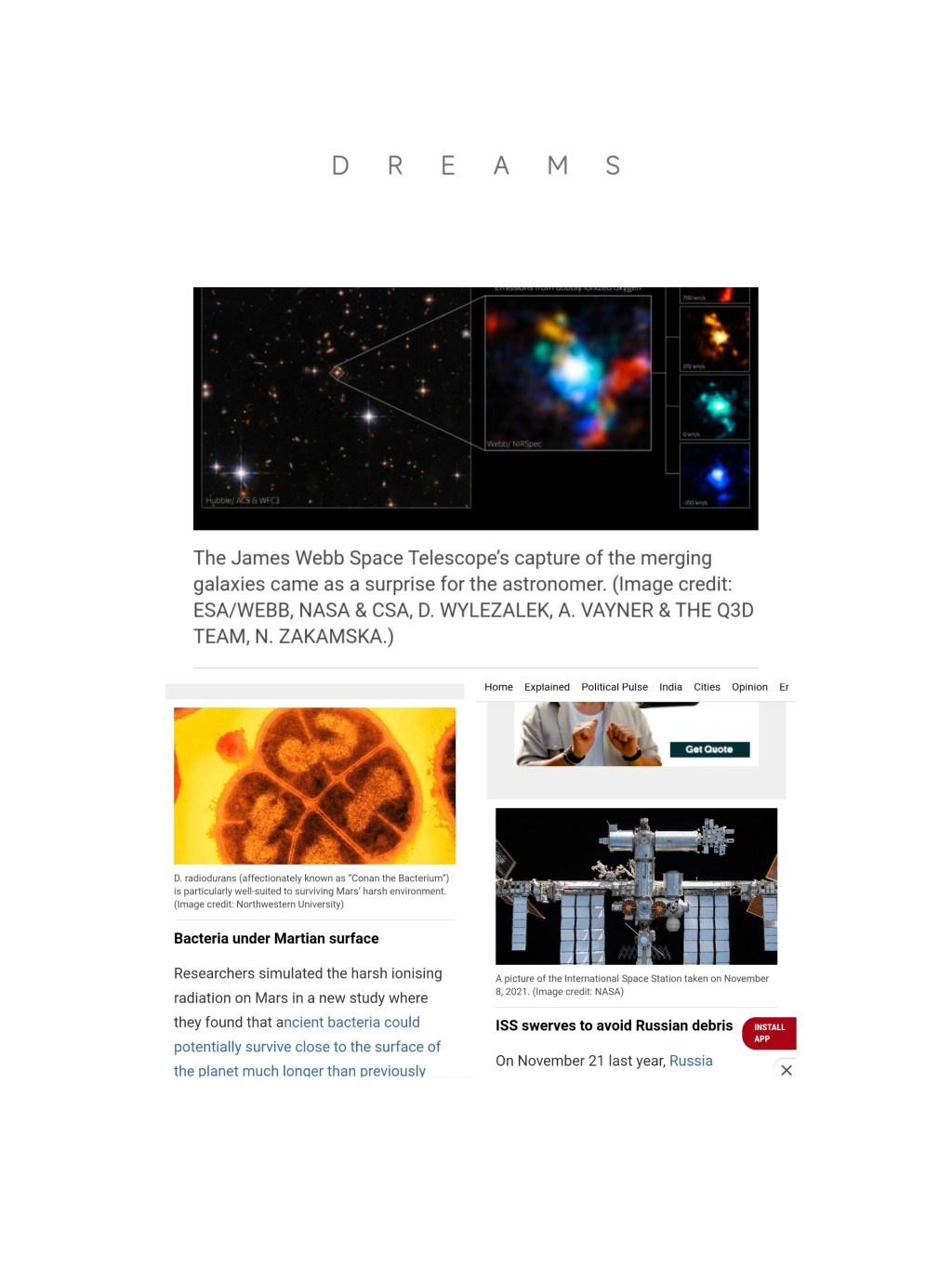
Galaxies merging, james webb space telescope The James Webb Space Telescope’s capture of the merging galaxies came as a surprise for the astronomer. (Image credit: ESA/WEBB, NASA & CSA, D. WYLEZALEK, A. VAYNER & THE Q3D TEAM, N. ZAKAMSKA.)
Webb captures galaxies merging near black hole
In what researchers are calling an “unprecedented” surprise, the James Webb Space Telescope has captured crisp images of multiple galaxies merging around a supermassive black hole. According to Johns Hopkins University, this image offers an opportunity to “observe how billions of years ago galaxies coalesced into the modern universe.”
ALSO REAd |Webb captures ‘unprecedented’ image of galaxies merging near supermassive black hole
The rare “extremely red” quasar in the image is about 11.5 billion light-years old and has a supermassive black hole at its centre. It is red in colour because of the clouds of dust and gas between the Earth and the gas near the black hole.
isro, isro news, isro rocket, Sriharikota: Indian Space Research Organisation (ISRO)’s heaviest rocket LVM3-M2 lifts-off from a launch pad at the Satish Dhawan Space Centre, in Sriharikota, Sunday, Oct. 23, 2022. The rocket successfully placed 36 broadband communication satellites of OneWeb, on ISRO’s maiden commercial mission. (PTI Photo/R Senthil Kumar)
Gaganyaan test flight set for February
Human spaceflight is the pinnacle of the aspirations for any space agency and ISRO is no different. A senior official for the space agency told PTI that it will start a series of test flights for India’s maiden human space flight mission on February 23. The Gaganyaan Mission was announced by Prime Minister Modi during his Independence Day address in 2018 with a tentative target date of 2022.
 techisolate